
Advertisement | By XINENGXING
Originally published: 2026-06-27. Updated for the XINENGXING English website.
A plant planned around 1,000 hotel linen sets per day needs a budget tied to the actual linen mix, working hours, local quotations and customer contracts. The source article contained inconsistent totals and unsupported profit forecasts. The historical figures below are retained only as clearly identified planning inputs, with arithmetic clarified where useful; they are not current quotations or a forecast of returns.
The source defined one set as one fitted sheet, one duvet cover, two pillowcases, one bath towel, one face towel and one bath mat. At 1,000 sets, that means 1,000 fitted sheets, 1,000 duvet covers, 2,000 pillowcases and 3,000 towel or mat items per day.
The source estimated a total dry mass of 3–5 tonnes. Weigh representative sets to confirm this assumption, and identify the peak workload, operating hours, rewash rate and required finishing standard. A set count alone does not establish machine capacity.
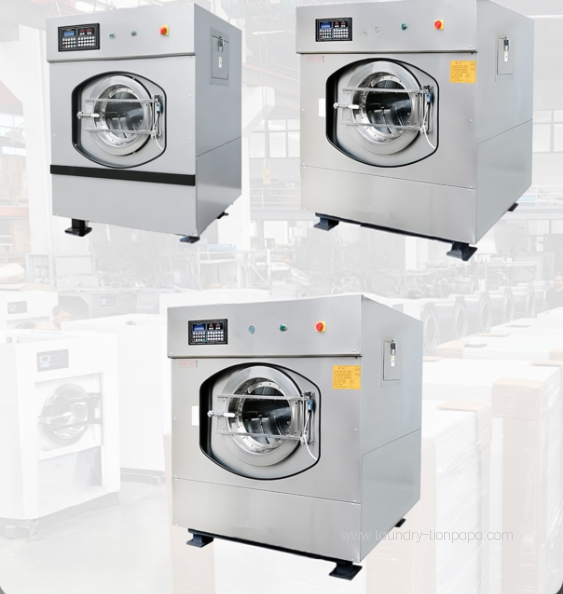
Washer-extractors: The source proposed either three to four 100 kg machines or four to five 50 kg machines. These are alternative starting configurations, not equivalent proven daily outputs. Check cycle time, loading, turnaround, shift length and downtime. Historical unit-price inputs were USD 8,500–21,500 for 100 kg models and USD 5,700–11,500 for 50 kg models; the original washer subtotal of USD 28,500–43,000 did not consistently represent all of those quantity and price combinations.
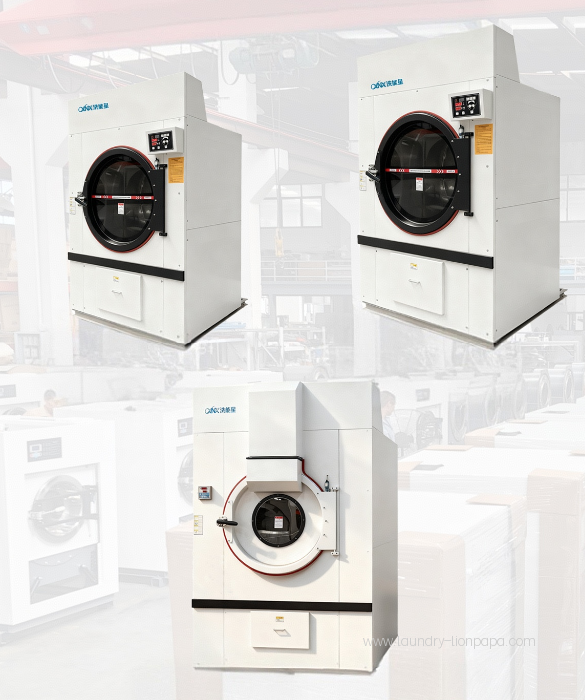
Tumble dryers: The source proposed two to three 100 kg units at USD 7,100–14,300 each, and a historical subtotal of USD 21,400–35,700. Calculate the selected quantity and quotation directly. Not every linen item necessarily follows the same dryer-to-ironer route; finishing requirements and residual moisture affect sizing.
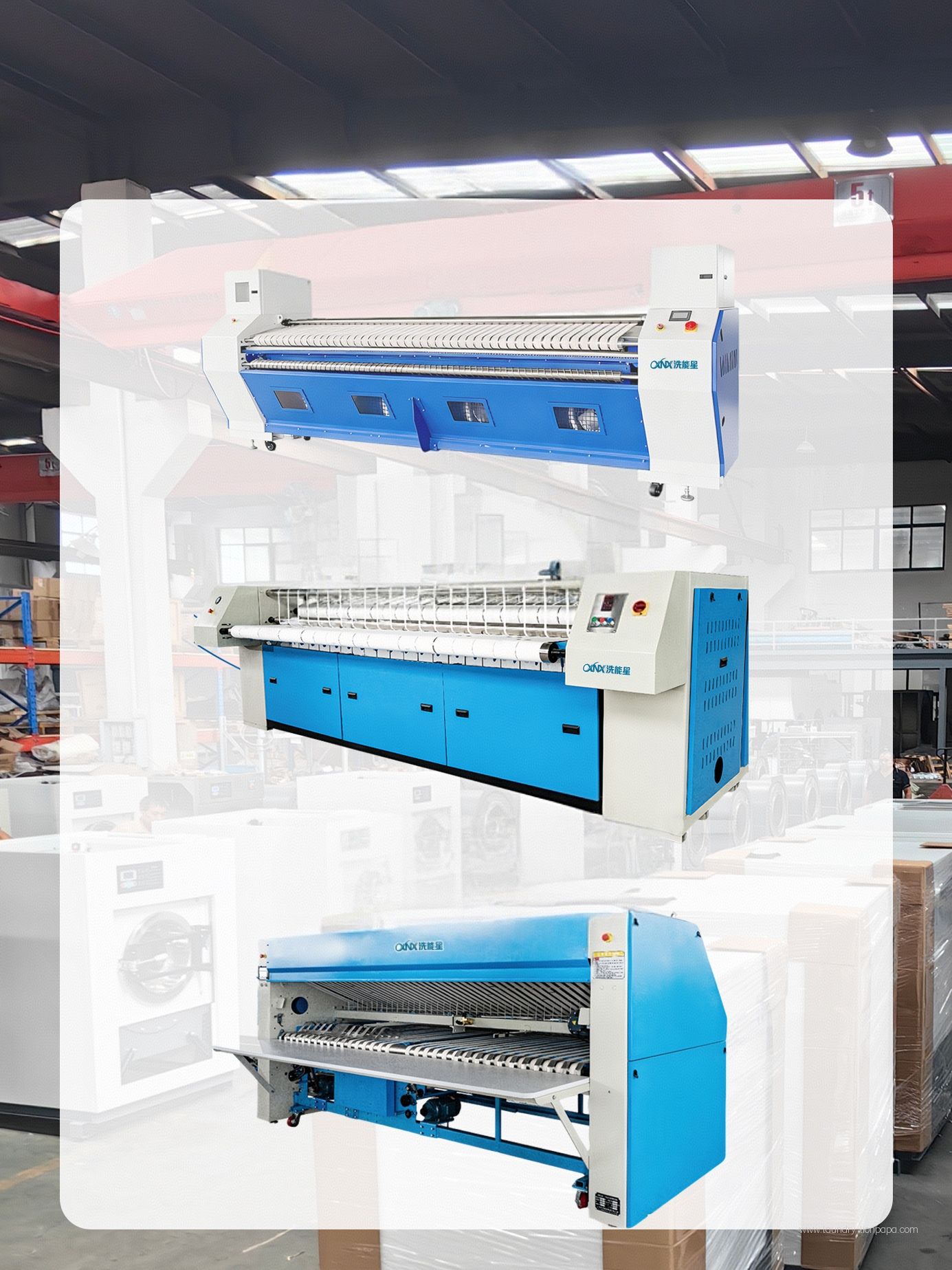
Flatwork ironing: A four-roll ironer was listed at USD 12,800–28,600. Select width, heating, feed speed and output for the actual linen mix; that configuration is not a universal minimum for 1,000 sets.
Folding: One automatic linen folder was listed at USD 10,000–21,400. Confirm compatible textile sizes, folding patterns, feed arrangements and rated throughput before assuming staffing savings.
Auxiliaries: Feeding conveyors, stackers, air compressors, water-treatment equipment, transport trolleys and workstations were grouped at USD 5,700–21,400. Specify which items are included and required.
Steam supply: A gas-fired boiler described as 0.5–1 tonne was listed at USD 7,100–14,300. Confirm whether the rating means steam output per hour, the required pressure, connected demand, permits and qualified installation. Electric steam generation changes electrical capacity and operating-cost requirements.
Adding the six historical equipment-category subtotals as printed gives USD 85,500–164,400, rather than the source’s stated USD 114,000–214,000. Because the quantity assumptions are also inconsistent, neither range should be used as a project quotation. Obtain an itemized bill of equipment including freight, duties, taxes, installation and commissioning. Compare actual specifications and support rather than assuming imported equipment has a longer service life.
The source proposed 300–500 square metres for washing, drying, ironing, folding, sorting, storage and office areas. Check the complete workflow, safe circulation, linen segregation, service clearances and utility rooms against the actual premises.
Historical annual rent was USD 21,400–57,100. Renovation inputs were USD 7,100–28,600 for floor preparation, drainage, ventilation, electrical capacity and steam pipework. A further USD 1,400–21,400 was allocated to environmental equipment and related work.
Those three ranges sum to USD 29,900–107,100 for the first year, rather than the source’s USD 42,800–107,100. Rent deposits, professional fees and other excluded items must be budgeted separately. Wastewater, exhaust, boiler and fire-safety requirements are location-specific; identify them before committing to a site.
Staffing: The source listed two to three sorters, two to three wash operators, one to two dryer attendants, two to three ironing staff, three to four folding staff, one to three drivers and one to two managers. These roles total 12–20 people if all are separate, not the stated 8–12. Shared roles, shifts and automation can change the plan. Using the source’s historical monthly wage input of USD 570–860 gives a simple payroll range of USD 6,840–17,200 per month for 12–20 people, before employer charges, overtime and other employment costs. Use lawful current local labour costs in the actual budget.
Water: The source assumed 40–80 litres per set, or approximately 40–80 cubic metres for 1,000 sets. At its hypothetical USD 0.57–1.14 per cubic metre input, simple multiplication gives USD 22.80–91.20 per day. With 26 operating days, that is USD 592.80–2,371.20 per month, before wastewater charges and fixed fees. The original daily and monthly amounts did not match these inputs.
Electricity: At the source’s 800–1,200 kWh per day and USD 0.11–0.17 per kWh, the calculation is USD 88–204 per day, or USD 2,288–5,304 for 26 days. Include any demand charges and confirm whether all heating equipment is included.
Gas or steam: The historical assumptions of 100–200 cubic metres of gas per day and USD 4.30–7.15 per cubic metre produce USD 430–1,430 per day, or USD 11,180–37,180 for 26 days. These rates are not verified current market rates and may dominate the budget; confirm the correct tariff units and fuel requirement locally.
Laundry chemicals: Main detergent, bleach where appropriate, neutralizer, softener and degreaser were listed. At a hypothetical USD 0.11–0.21 per set, 1,000 sets cost USD 110–210 per day, or USD 2,860–5,460 over 26 days. Select chemistry and dosing through the approved wash process rather than solely by price.
Packaging and transport: The source allowed USD 714–1,428 per month for bags, fuel and vehicle maintenance. Confirm route distances, fleet costs and packaging requirements.
Maintenance and depreciation: The source listed routine maintenance of USD 4,286–11,428 annually and assumed a five-to-eight-year depreciation period. Depreciation must be calculated from the applicable asset cost, residual value and accounting or tax policy; it is not proof of equipment life and differs from a cash expense. The source’s fixed depreciation range was not supported by a consistent asset basis.
Other overheads: Historical inputs of USD 428–857 per month covered insurance, wastewater-treatment chemicals, office supplies and communications. Add financing, taxes, administration, permitted waste handling and other actual costs without double counting.
The source’s overall monthly and annual operating totals were inconsistent with the line items. Build a fresh budget using a single operating-day assumption, current local inputs and separate cash-flow and accounting-profit views.
Historical per-piece examples in the source were: fitted sheet USD 2.15–4.30; duvet cover USD 2.85–5.70; pillowcase USD 0.71–1.43; bath towel USD 1.43–2.85; face towel USD 0.71–1.43; and bath mat USD 0.71–1.43. These are unverified historical examples, not standard market prices. With two pillowcases, summing those endpoints gives USD 9.27–18.57 per defined set.
The source separately assumed an all-in set price of USD 11.40–20.00. If that hypothetical contract rate were achieved for 1,000 paid sets every operating day, gross revenue would be USD 11,400–20,000 per day, USD 296,400–520,000 for 26 days, and USD 3,556,800–6,240,000 for 12 identical months. The much smaller annual revenue printed in the source was inconsistent. These calculations only illustrate multiplication and do not establish demand, collections or profit.
Linen rental adds linen purchasing, replacement, inventory and contract responsibilities. The source cited USD 42,800–71,400 for initial linen stock. Validate the required par stock, purchase quality and replacement rate; rental does not automatically produce a higher margin.
Customer mix and pricing: Assess quality requirements, volumes and service commitments for each hotel contract. A mixture of customers may reduce concentration risk, but prices and margins need to be assessed individually.
Utilization: Compare contracted and peak loads with the actual capacity of each production stage. Test low-demand scenarios rather than assuming 60% or 80% utilization is a universal profitability threshold.
Labour productivity: Map tasks and measure throughput before changing staffing. Automation may assist ironing and folding, but the source’s claimed removal of two to three jobs and fixed annual savings was not supported by a defined workflow.
Utilities: Measure water, electricity, fuel and steam per processed kilogram or set. Their share of cost varies by tariffs, equipment and process; use site data instead of a fixed percentage.
Linen losses: Track missing, damaged and rejected items and define responsibility in customer contracts. RFID or other tracking may support this work where compatible with the textiles and workflow.
Receivables: Negotiate payment terms and model collection delays. The source discussed 30–90-day terms as an example; actual contracts determine the working-capital requirement.
Compare automated ironing and folding with the full cost of installation, maintenance, training and staffing. Test changes to wash programmes with appropriate quality controls; reducing temperature or chemical dose must not compromise the required process.
Additional services can include linen rental, mending, specialist stain treatment or expedited processing where the plant has suitable capability. Price each against its incremental cost and capacity impact.
Compare supply contracts and bulk purchasing for detergents and packaging, allowing for storage, shelf life and cash tied up in stock. Assess water-reclamation treatment, permitted reuse, testing and maintenance rather than assuming a 30–50% saving.
Where the tariff allows, assess off-peak production scheduling alongside staffing, delivery deadlines and peak-capacity requirements.
Test the loss of a major client and avoid relying on one or two contracts without a contingency plan. The appropriate number of clients and concentration limit depends on contract value, financial resilience and local demand, rather than a universal five-to-eight-client rule.
Assess competitive pricing, labour-cost changes, wastewater and emissions requirements, breakdowns and delayed payments. Reserve working capital and funds for required upgrades.
The original net-profit and six-month-to-three-year payback claims cannot be supported by its inconsistent cost and revenue figures and are not repeated as forecasts. A useful decision requires a coherent project budget, confirmed contracts, current quotations and sensitivity analysis.
XINENGXING can discuss equipment configuration for small, medium and large linen-processing operations. Provide the daily textile mix, dry weight, operating hours, site conditions and budget to request a project-specific proposal.